PT. Karet Ngagel Surabaya Wira Jatim
Fabric Conveyor Belt
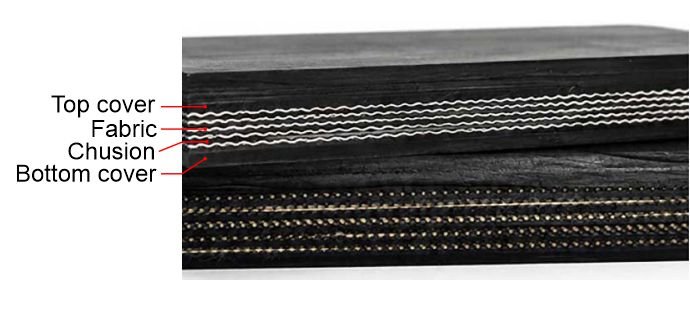
General Structure
A fabric conveyor belt consists of two main components, the carcass and the cover.
The carcass comprises one or more layers of textile fabric coated with rubber on both sides, known as cushion layers to provide adhesion and flexibility.
The most commonly used fabric constructions are Polyamide-Polyamide (NN), and Polyester-Polyamide (EP).
Selection of carcass by service conditions
| Carcass | Features and service conditions |
|---|---|
| NN (Nylon fabric) | High impact resistance |
| High bending resistance | |
| Wide selection available | |
| EP (Polyester fabric) | Short take-up travel |
| Heavy duty, high speed, deep trough | |
| Long span, high tension, tear resistance | |
| Impact resistance |
Series of fabric conveyor belt
| Belt | Fabric Type | Ply | Cover Thickness (mm) | Width (mm) | |
|---|---|---|---|---|---|
| Top | Bottom | ||||
| Nylon Conveyor Belt | NN100 | 2 - 10 | 3 - 12 | 1.5 - 6 | 500 - 2200 |
| NN125 | |||||
| NN150 | |||||
| NN200 | |||||
| NN250 | |||||
| NN300 | |||||
| NN400 | |||||
| NN500 | |||||
| EP Conveyor Belt | EP100 | 2 - 8 | |||
| EP125 | |||||
| EP150 | |||||
| EP200 | |||||
| EP250 | |||||
| EP300 | |||||
| EP350 | |||||
| EP400 | |||||
| EP500 | |||||